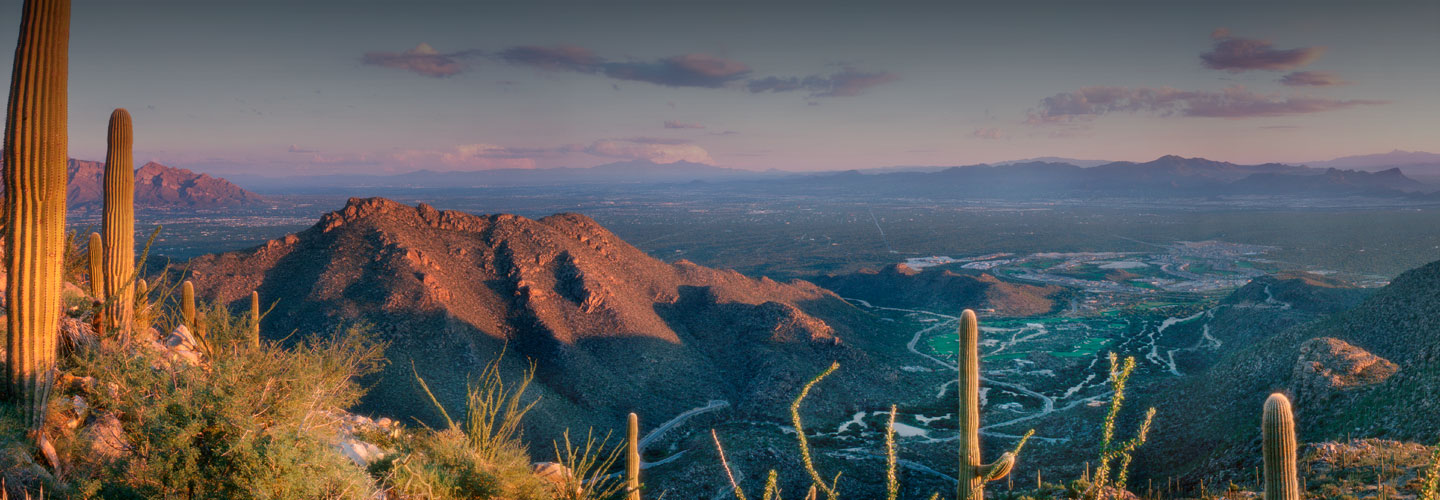

Dove Mountain: Wild at Heart
Where the Sonoran Desert’s Wildlife Corridors Come to Life
There is a moment, just before sunrise, when Dove Mountain belongs entirely to the wild. A mule deer moves silently through the arroyo. A great horned owl calls from the ridgeline. Somewhere in the dark above the Tortolita Mountains, a migrating raptor catches the first thermal of the morning. You haven’t left home to find this. You’re standing on your own patio.
That is the promise of Dove Mountain — and it is a promise kept each day of the year.
Nestled in the northwest corner of Tucson, this luxury community is far more than a place to live. It’s a front-row seat to one of the American Southwest’s most extraordinary natural spectacles: the continuous, seasonal movement of wildlife through a living network of protected lands and desert corridors that stretch from the valley floor to the sky islands of Mount Lemmon and beyond.
Built on the Land, Not Over It
Dove Mountain was designed from the beginning with nature as a coequal resident. Nearly one-third of the community is dedicated to open space, a commitment that shapes everything from street layouts to backyard views. The community shares borders with the 3,100-acre Tortolita Mountain Park and the 2,400-acre Dove Mountain Preserve, for a combined protected Sonoran Desert habitat footprint of more than 5,500 acres right at the community’s edge.

No community in Northwest Tucson shares more protected land along its border than Dove Mountain, with a full 10 miles of interface between homes and wildlands. That boundary is not a wall. It is an invitation.
Wildlife connectivity is built into townwide development standards. Washes and riparian corridors must be maintained as open habitats in new construction. And along Tangerine Road, five dedicated wildlife underpasses between Dove Mountain Boulevard and La Cañada Drive allow native species, including coyotes, mule deer, bighorn sheep, mountain lions, javelina, desert tortoise, snakes, and more, to move freely beneath the roadway, crossing between territories without interruption. The Sonoran Desert doesn’t stop at the community gate. It flows right through it.
The Corridor and Beyond: A Web of Connected Wildlands
To understand why Dove Mountain is such a remarkable destination for wildlife observation, it helps to think of landscapes rather than property lines.
The Tortolita Mountains anchor the community to the north and east, forming part of a broader network of sky islands that define the ecology of southern Arizona. These mountain ranges rise dramatically from the desert floor and act as biological bridges, connecting lowland Sonoran Desert habitat to the pine forests and alpine meadows of the Santa Catalinas, the Rincons, and eventually the high peaks of the Sky Island Archipelago, a chain of isolated mountain ranges stretching into Mexico.
Mount Lemmon, the highest point in the Santa Catalina range at just under 9,200 feet, is less than two hours from Dove Mountain. The elevation change from the valley floor to its summit compresses multiple climate zones into a single drive — the ecological equivalent of traveling from Mexico to southern Canada. That gradient is part of what makes southern Arizona one of North America’s most biodiverse regions. It also gives Dove Mountain a revealing vantage point.
For the adventurous, the Tucson Mountains to the south and Saguaro National Park’s west unit offer an easy half-day excursion into pure Sonoran Desert wilderness. Farther afield, Madera Canyon in the Santa Ritas has earned its reputation as one of the top birding destinations on the continent.
But you don’t have to go anywhere at all. Because at Dove Mountain, the migration comes to you.
Migrating Species: When and How to See Them
The wildlife calendar at Dove Mountain runs year-round, with each season bringing its own cast of characters to the trails, washes, and open skies surrounding the community.
Summer: Wings, Water, and the Monsoon Bloom
Summer in the Sonoran Desert is not a dormant season — it is a crescendo. When the monsoon arrives in July and August, the desert transforms almost overnight. Washes run with water. Wildflowers explode along the roadsides. And the insect life that fuels the broader food chain surges into abundance.
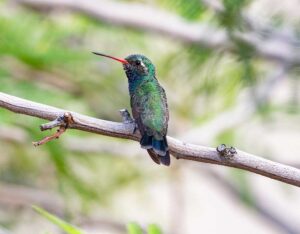
That abundance draws hummingbirds into impressive numbers. Black-chinned and broad-billed hummingbirds are regular summer visitors, drawn by blooming ocotillo, salvia, and desert honeysuckle. Rufous hummingbirds begin appearing as early as late July, already on their southward migration from breeding grounds as far north as Alaska — one of the longest migration routes of any bird in the world.
Summer evenings belong to the bats. Mexican free-tailed bats emerge at dusk from roost colonies throughout the region, often in columns that darken the sky. Watching from a patio or a community trail as dusk falls over the Tortolitas is unforgettable.
Monsoon season also brings a flush of butterfly activity. Queen butterflies, pipevine swallowtails, and a parade of sulfurs move through the desert in numbers that peak after significant rain events, drawn by nectar sources that appear and vanish within days.
Fall: The Monarch Passage and Raptor Watch
October is the month that draws the most dedicated wildlife observers to Dove Mountain. It’s monarch butterfly season — and southern Arizona sits directly within one of the primary migration corridors linking the butterfly’s summer breeding range to its wintering grounds in the mountain forests of central Mexico.

Monarchs travel in waves, often congregating in desert washes and canyon mouths where nectar is still available. Watching a cluster of monarchs nectaring on late-blooming desert marigold or rabbitbrush, their orange and black wings catching the low October sun, is one of the genuine wildlife experiences the Southwest offers to those paying attention.
Fall also marks the beginning of the raptor migration. Red-tailed hawks and Swainson’s hawks move through in numbers. Northern harriers begin appearing over open grasslands. The occasional golden eagle passes overhead, riding thermals south toward Mexico. For birders, the weeks between late September and November offer some of the most productive observations of the year.
Winter: Cranes, Sparrows, and the Deer in the Wash
Winter at Dove Mountain is mild by any standard — and for wildlife, it’s a season of reliable abundance. Coues white-tailed deer, the compact, gray-coated subspecies native to the sky island ranges, become more visible as vegetation thins and their territorial movements increase. It’s not unusual to count a dozen or more along a single morning trail walk.
Wintering sparrows arrive in mixed flocks, working the dried seed heads of desert grasses along the community’s open spaces. White-crowned sparrows, Lincoln’s sparrows, and the occasional grasshopper sparrow join year-round residents like the canyon towhee and curve-billed thrasher.
For those willing to make the short drive to the San Pedro River corridor or the managed wetlands southeast of Tucson, winter offers one of the most otherworldly wildlife experiences in North America: the arrival of sandhill cranes. Between November and February, tens of thousands of cranes stage at Whitewater Draw and the nearby Willcox Playa — their bugling calls audible from a mile away, their mass flights at dawn and dusk unlike anything else on the continent.
Spring: The Return and the Renewal
Spring migration begins quietly, with the first male hummingbirds returning from Mexico in February — their arrival a reliable signal that the season is turning. By March, the blooming saguaros and palo verdes attract a parade of migrating songbirds working their way north: warblers, vireos, flycatchers, and tanagers moving through in waves that can pack dozens of species into a single morning.
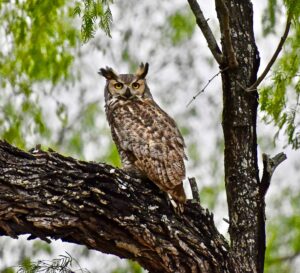
Early monarchs appear again in March and April, northbound now, their population replenished by a new generation hatched on milkweed in northern Mexico. Cactus wrens build nests in the cholla. Gambel’s quail lead their improbably large broods across the trails. And somewhere in the Tortolita foothills, a great horned owl is raising the next generation within an established nesting territory.
How to See It: Vantage Points and Viewing Tips
Dove Mountain’s trail network and open spaces offer natural observation platforms that require nothing more than patience and a pair of binoculars. The community’s border with Tortolita Mountain Park provides direct trail access into undisturbed habitat, where dawn and dusk movements are most reliably productive.
Patios and backyards in the foothill neighborhoods offer surprising visibility. The combination of elevation, open desert views, and proximity to the preserve boundary puts residents at eye level with ridge-top raptors and within earshot of coyote choruses that reliably begin at sunset.
For serious birders and wildlife photographers, the community’s washes are the key. Seasonal water draws species that wouldn’t otherwise be visible in the open desert, and the riparian vegetation that lines the washes creates movement corridors that concentrate wildlife into predictable zones.
Across Dove Mountain, elevations range from 2,700 to 4,300 feet, providing a thermal advantage over the lower Tucson basin. Mornings are cooler and wildlife activity extends further into the day than it does at lower elevations.
A Place to Live Inside the Wild
There are communities where nature is a backdrop, a pleasant view from the window. Dove Mountain is different. Here, nature is an active presence, a daily reality, and a reason to step outside every single morning to see what arrived overnight.
The wildlife corridors that cross beneath Tangerine Road connect to preserves that extend toward the region’s sky islands. Migration routes bring monarchs, hummingbirds, and raptors directly through the community. The same protected lands that shelter mountain lions and bighorn sheep begin at the end of the trail.
This is not a coincidence. It is the result of deliberate planning, sustained conservation commitment, and an extraordinary piece of Sonoran Desert landscape. It’s also simply one of the most remarkable places in the American Southwest to call home.
At Dove Mountain, you don’t have to leave to find the wild. You’re already there.
Find Your Place in Nature
Dove Mountain offers customizable and quick move-in homes, lock-and-leave villas, golf course residences on or near three acclaimed Arizona courses, and custom estates set within saguaro-studded high desert landscapes.
To learn more, visit the community’s Sales and Information Center at 13900 N. Dove Mountain Boulevard or call (520) 572-8000 to schedule a tour. Model homes are open daily.
